

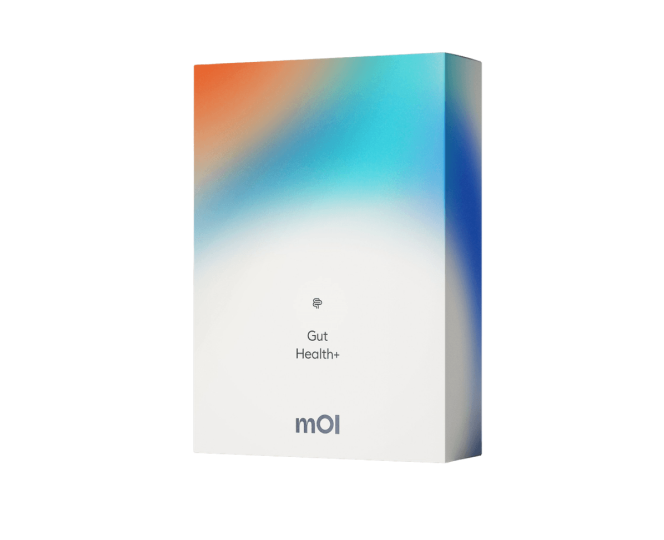

Gut Health+
- Faecal calprotectin: a protein that rises when your gut lining is inflamed. Normal levels can help rule inflammation out. Used in the investigation of IBD.
- Secretory IgA (sIgA): the main antibody protecting your gut lining, showing how well your gut’s immune defences are working.
- qFIT: checks for tiny traces of blood in your stool that you can’t see, using the same method as NHS bowel cancer screening.
- IBD SIGNAL: supports the assessment of inflammatory bowel disease (IBD)
- Sample: Stool collected at home
- Results: within 15 working days of lab receipt
- Self-sampling: Collect sample at home using the supplied kit
- Sample: Stool collected at home
- Results: within 15 working days of lab receipt
- Self-sampling: Collect sample at home using the supplied kit
What we measure & why it matters
Four parts from a single stool sample:
- Faecal calprotectin: a protein released when the gut lining is inflamed. Higher levels can suggest inflammation, and normal levels can help rule it out as the cause of your symptoms.
- Secretory IgA (sIgA): the main antibody protecting your gut lining. It shows how well your gut’s immune defences are working.
- qFIT: checks for tiny traces of blood in your stool that you can’t see.
- IBD SIGNAL: a UKCA-marked metagenomic test from Salient Bio, supporting the assessment of inflammatory bowel disease (IBD), including Crohn’s disease and ulcerative colitis.
IBD SIGNAL is a test developed by our partner Salient Bio. It is a UKCA-marked in vitro diagnostic (IVD) medical device, registered with the MHRA. It looks at the bacteria and other microbes in your stool sample (your gut microbiome) and checks how closely they match the pattern seen in people diagnosed with inflammatory bowel disease (IBD), which includes Crohn’s disease and ulcerative colitis.
Your result is shown as a likelihood score between 0 and 1. A score at or above 0.5 means your sample resembles the microbiome profile of people who have been diagnosed with IBD, which is a reason to speak to your GP or specialist about further investigation. A score below 0.5 means your sample doesn’t resemble that profile. If your symptoms continue, please still speak to your doctor, as other conditions can cause similar symptoms.
In a validation study of 956 people, IBD SIGNAL correctly identified 90.3% of people who had IBD and 92.3% of people who did not. No test is 100% accurate, so IBD SIGNAL doesn’t give a diagnosis on its own: your result should be discussed with your GP or specialist, alongside your symptoms and any other tests. IBD SIGNAL is for adults aged 18 and over with ongoing gut symptoms.
This test may be right for you if you’ve been living with symptoms such as ongoing diarrhoea, abdominal pain, bloating or discomfort after eating and want to know whether inflammatory bowel disease could be involved, especially if you’ve been told it might be IBS. It’s also useful if you’re managing a condition that affects your gut, taking medication that can affect it, or want the fullest baseline we offer to track your gut health over time.
You collect your sample at home, with no appointment needed, and your results arrive in the mOI app, ready to share with your GP. Gut Health+ is for adults aged 18 and over.
If you notice blood in your stool, a change in your bowel habit lasting more than three weeks, unexplained weight loss or severe abdominal pain, please see your GP now rather than waiting for a test.
Gut Health measures three stool markers that can show whether something may be going on in your gut. Gut Health+ includes the same three markers and adds IBD SIGNAL, a UKCA-marked metagenomic test developed by our partner Salient Bio, which supports the assessment of inflammatory bowel disease (IBD), including Crohn’s disease and ulcerative colitis. Both use the same single stool sample.
No. qFIT uses the same method as the NHS bowel cancer screening programme to look for tiny traces of blood, but a positive result doesn’t tell you why blood is there. It can have many causes, including haemorrhoids and inflammation. Any positive result should be discussed with your GP. This test isn’t a replacement for NHS bowel cancer screening, so if you’re invited for screening, please still take part.
These markers can show signs that something may be going on, and IBD SIGNAL shows how closely your gut microbiome matches the profile of people diagnosed with IBD, but this test can’t diagnose IBD or any other condition on its own. A score at or above 0.5 means your sample resembles that profile, not that you have IBD, and a score below 0.5 doesn’t rule it out. No test is 100% accurate: in its validation study, IBD SIGNAL correctly identified 90.3% of people who had IBD and 92.3% of people who did not, so a small number of results will be false positives or false negatives. IBD SIGNAL also can’t tell Crohn’s disease and ulcerative colitis apart, and an IBD diagnosis is usually confirmed by a specialist, often with a colonoscopy. A normal result doesn’t rule out every gut condition, and an abnormal result may need further investigation. If your symptoms continue, even with normal results, it’s worth going back to your GP.
A structured path to Immune Intelligence
Choose your test
Select the test that’s right for you
Start with what you want to explore or understand
Receive your kit
Your test kit is delivered to your door
Everything you need, ready for your sample
Provide your sample
Follow the instructions in your kit or book an at home visit for blood collection.
Simple, guided steps depending on your test
Send your sample to the lab
Your sample is securely prepared and
sent for analysis
Handled with care to maintain quality
View your results and insights
See your results in the app, connected to your health over time
Helping you make sense of what’s changing
Frequently asked questions
Gut Health asks three questions about your gut. Gut Health+ adds a fourth: could inflammatory bowel disease be part of the picture?
Gut Health+ includes everything in Gut Health: faecal calprotectin for inflammation, secretory IgA for your gut’s immune defences, and qFIT for hidden blood. It then adds IBD SIGNAL, a UKCA-marked in vitro diagnostic (IVD) test developed by our partner Salient Bio, which supports the assessment of inflammatory bowel disease (IBD), including Crohn’s disease and ulcerative colitis.
It all comes from a single stool sample you collect at home. Your results arrive in mOI alongside the symptoms and data you track, ready to share with your GP, and repeat testing over time can show how your results are changing. IBD SIGNAL is for adults aged 18 and over.
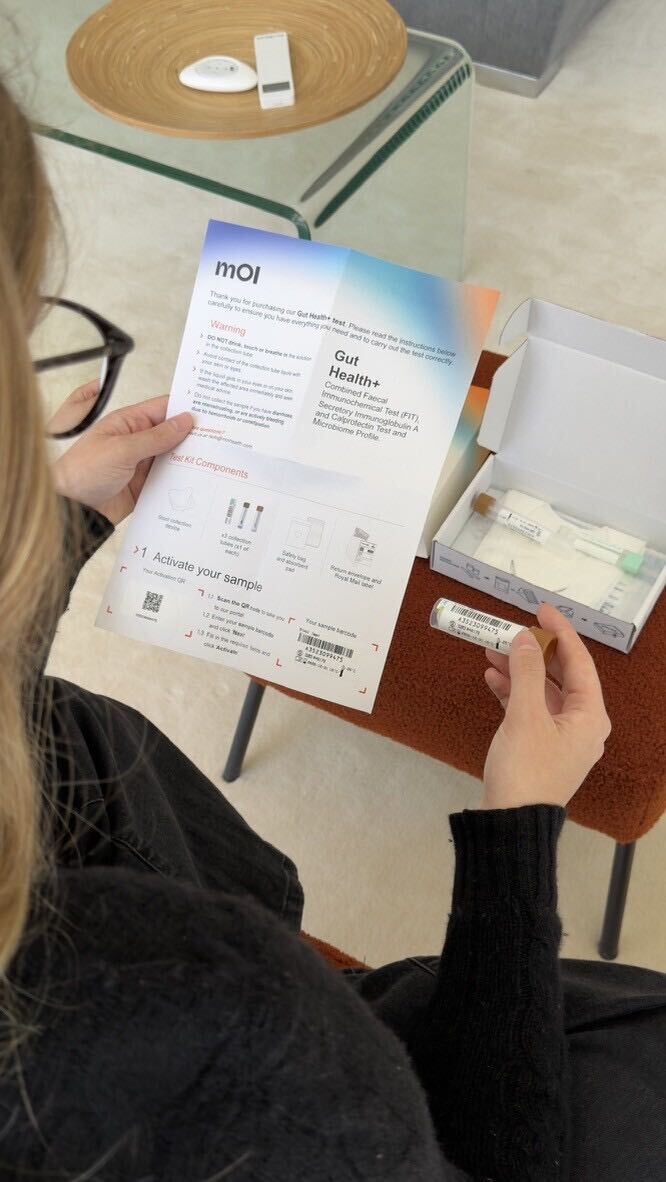
Your stool collection kit is posted to you in secure packaging. It contains:
- sample collection tubes
- a collection device to help you take your sample
- an information leaflet with step-by-step instructions
- a specimen bag
- prepaid return packaging
You don’t need a phlebotomist or an appointment. You collect your sample at home, following the instructions in the kit. Your sample needs to be posted back on the same day you collect it, so try to collect it on a day when you can get it in the post straight away. Once you’ve collected it, seal it in the tubes provided and send it back in the prepaid return packaging. Results will be available after your sample has been received and processed by the lab.
Gut inflammation
Faecal calprotectin When the gut lining is inflamed, white blood cells flood the area and release a protein called calprotectin. The more inflammation there is, the more of it shows up in your stool. High levels can suggest something inflammatory is going on. Normal levels can help rule out inflammation as the cause of your symptoms, which matters if you’ve been told it might be IBS. It’s the same marker NHS gastroenterology uses to help decide whether further investigation is needed.
Mucosal immune function
Secretory IgA (sIgA) Your gut is one of your body’s most important immune barriers, and secretory IgA is the antibody that holds that barrier together. It patrols the gut lining, neutralises threats, and stops harmful substances from crossing into the bloodstream. Measuring it in stool tells you how well that defence system is working. Low levels may mean the gut’s immune defences are depleted. Higher levels may mean the immune system is responding to something, whether that’s a pathogen, a food trigger, or ongoing inflammation.
Occult blood detection
qFIT (quantitative faecal immunochemical test) Sometimes there’s blood in the stool that you’d never know about because you can’t see it. qFIT is designed to find it. It uses the same method as the NHS bowel cancer screening programme to detect tiny traces of human blood. A positive result doesn’t tell you why it’s there, but it gives you and your clinical team something real to investigate. For anyone taking anti-inflammatory medication long-term, or managing a condition that affects the gut, that’s an important thing to know.
IBD assessment
IBD SIGNAL Inflammatory bowel disease (IBD), which includes Crohn’s disease and ulcerative colitis, can take a long time to diagnose, partly because its symptoms overlap with other gut conditions such as IBS. IBD SIGNAL is a UKCA-marked in vitro diagnostic (IVD) test developed by Salient Bio and registered with the MHRA. It looks at the bacteria and other microbes in your stool sample and checks how closely they match the pattern seen in people diagnosed with IBD, giving a likelihood score between 0 and 1. Faecal calprotectin is very sensitive to inflammation in the gut but can’t tell you what is causing it, as levels can also rise with infections, coeliac disease and some medicines. Because IBD SIGNAL looks for a microbial pattern linked to IBD itself, rather than inflammation in general, the two together can give you and your GP a clearer picture of whether further investigation is needed.
- Try to collect your sample in the morning if you can. It makes it easier to get it in the post the same day.
- Avoid collecting your sample during your period, as this can affect results.
- If you’ve had a colonoscopy or bowel prep in the last 2 weeks, wait before collecting.
- Let your GP or clinical team know about any medications you’re taking, particularly NSAIDs or iron supplements, as these may affect your results.
- Seal your sample securely in the collection tubes provided, following the instructions in your kit.
- Place it in the prepaid return packaging and post it back on the same day you collect it.
- If you feel unwell or have any concerns after collection, contact your GP or local NHS service for advice.
- For general guidance on stool sample collection, you can visit the NHS website: https://www.nhs.uk/conditions/stool-tests/
mOI Gut Health+ measures four components from a single stool sample: faecal calprotectin, secretory IgA, qFIT and IBD SIGNAL. Each provides information about a specific aspect of gut health, and results should be read as part of a broader picture. IBD SIGNAL’s result can be affected by recent antibiotics, diet, medication or illness, so a single result at a single point in time has limits, and what’s considered within range can vary depending on individual circumstances. IBD SIGNAL gives a likelihood score between 0 and 1 showing how closely your gut microbiome matches the profile of people diagnosed with IBD, with a threshold of 0.5. It doesn’t give a diagnosis on its own, your result should be discussed with your GP or specialist, and no test is 100% accurate. IBD SIGNAL is for adults aged 18 and over.
This test doesn’t provide a diagnosis. Your results are intended to support your understanding of your gut health and may help inform conversations with your clinical team. They shouldn't be used as the sole basis for any medical decision.
If you notice blood in your stool, a change in your bowel habit lasting more than three weeks, unexplained weight loss or severe abdominal pain, please see your GP now rather than waiting for a test. This test doesn’t replace NHS bowel cancer screening, so if you’re invited for screening, please still take part.
mOI is a UKCA marked Class I medical device, self-certified under UK MDR 2002. IBD SIGNAL is a UKCA-marked in vitro diagnostic medical device manufactured by Salient Labs Limited and registered with the MHRA. All tests are processed by Salient Bio, which is accredited by UKAS to ISO/IEC 17025:2017 under laboratory number 22223. This test isn’t a substitute for clinical assessment or advice from a qualified healthcare professional.
We aim to get your results to you within 15 working days of your sample reaching the lab, though this can occasionally take longer for reasons outside our control. Turnaround times are estimates, not guarantees, and are subject to our Terms and Conditions of Sale. Most results appear directly in the mOI app, linked to your health record, alongside your tracking data and insights. For some tests, including certain gut health results, you may receive a PDF report instead. Where this applies, we’ll tell you at the time. If you’ve closed your mOI account by the time your results are ready, we’ll send them to the email address you gave us.
Your results will show which markers fall outside the normal range. That isn’t a diagnosis, but it’s worth discussing with your GP, who can decide whether you need further tests or a referral to a specialist such as a gastroenterologist. If your qFIT result is positive, please speak to your GP promptly. Your results are in the mOI app, ready to share. If your symptoms continue, even with normal results, it’s still worth going back to your GP.
No. The price of Gut Health+ includes your collection kit and prepaid return postage, and all prices include VAT. There’s no phlebotomy visit to pay for, because you collect your sample at home.
You’ll need a free mOI account to buy a test, but you don’t need a referral from your GP. Tests are priced separately, and all prices include VAT. Your account gives you access to your results, longitudinal tracking, and insights that connect your data over time. If you’re not a member yet, you can create a free account to get started.
Your health data is handled securely and protected under UK data protection law. You can read more about how we use and protect your data in our Privacy Notice.